The Expiration Date Fiction: What Supplement Manufacturers Are Actually Required to Prove—and When
There is a widespread assumption among supplement consumers that the expiration date on a bottle represents a hard scientific boundary—a moment at which a product transforms from effective to inert, or worse, harmful. That assumption is not supported by the regulatory framework governing dietary supplements in the United States, and in many cases, it is not supported by the underlying chemistry either.
The reality is more nuanced, more variable, and in some respects more concerning than a simple date on a label would suggest.
What the FDA Actually Requires
Under current federal regulations, dietary supplement manufacturers are not required to submit expiration date data to the Food and Drug Administration before bringing a product to market. Unlike pharmaceutical drugs—which must undergo formal stability testing protocols defined by the FDA's Center for Drug Evaluation and Research—dietary supplements operate under a different regulatory architecture established by the Dietary Supplement Health and Education Act of 1994.
Manufacturers who choose to include an expiration or "best by" date on their labeling (which is not universally mandated) are required under Good Manufacturing Practice regulations to have substantiation for that date. In practice, this typically means conducting accelerated stability testing—exposing the product to elevated temperature and humidity conditions for a compressed period and extrapolating results to a real-time shelf life estimate.
The critical detail is the testing window. Most commercial stability studies for supplements run between 12 and 36 months. A product assigned a three-year expiration date may have been tested under real-time conditions for only a fraction of that period, with the remainder of the shelf life estimated through mathematical modeling. The date on the label is often a projection, not a confirmed endpoint.
Expired Versus Degraded: A Distinction That Matters
These two terms are frequently conflated, but they describe meaningfully different states.
An expired supplement is one that has passed the date the manufacturer has printed on the label—a date that, as established above, represents a regulatory and commercial commitment rather than a precise biochemical threshold.
A degraded supplement is one in which the active compounds have undergone sufficient chemical breakdown to meaningfully reduce potency or, in rarer cases, produce compounds that are not present in the fresh product. Degradation is a real phenomenon, but it is driven primarily by environmental conditions—light exposure, temperature fluctuations, humidity, and oxygen contact—not by the passage of time alone.
A supplement stored properly in a cool, dark, low-humidity environment may retain substantially more of its labeled potency past its printed date than a supplement stored improperly that has not yet reached that date. The date without the storage context is, at best, an incomplete signal.
Which Nutrients Degrade Most Rapidly
Not all supplement ingredients age equally. Understanding the relative stability of common compounds can help consumers prioritize which products warrant closer scrutiny.
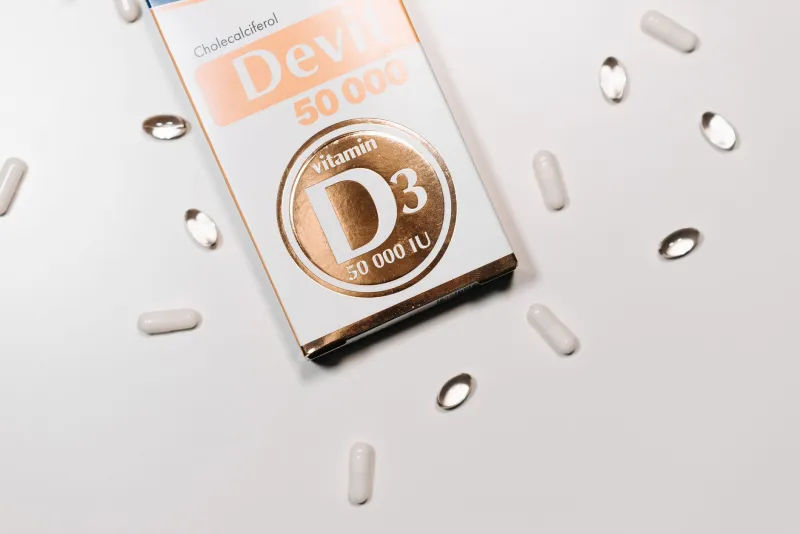
Fat-soluble vitamins (A, D, E, K) are generally more stable than water-soluble counterparts when protected from light and oxygen, but they are vulnerable to rancidity when the carrier oils in softgel formulations oxidize. A fish oil capsule or vitamin D softgel stored in a warm car or on a sunny windowsill may degrade significantly within weeks, regardless of what the label says.
Vitamin C (ascorbic acid) is among the most environmentally sensitive compounds in common supplement use. Exposure to air, heat, and moisture accelerates its oxidation into dehydroascorbic acid and ultimately to compounds with no vitamin activity. Powdered or chewable vitamin C formulations are particularly vulnerable.
B vitamins, especially folate and B12, can degrade meaningfully under humid conditions or prolonged light exposure. Methylated forms (methylfolate, methylcobalamin) may be somewhat more reactive than their synthetic counterparts.
Probiotics present a distinct challenge. The organisms in a probiotic supplement are living and subject to die-off under any conditions that deviate from optimal. Refrigerated products maintain viability longer, but even cold-chain products experience measurable CFU reduction over time. A product that listed ten billion CFU at manufacture may contain a fraction of that count by the time it reaches your cabinet.
Minerals in well-formulated inorganic or chelated forms are among the most stable supplement ingredients and are generally the least affected by age-related degradation under reasonable storage conditions.
The Storage Conditions the Industry Underemphasizes
The supplement industry has invested considerable effort in packaging aesthetics—amber glass bottles, foil-sealed caps, moisture-absorbing desiccant packets—but has been less aggressive in communicating the degree to which storage location determines product integrity.
The bathroom medicine cabinet, where a significant proportion of American households store their supplements, is one of the worst possible environments for most products. Daily shower use creates repeated humidity spikes and temperature fluctuations that accelerate degradation in moisture-sensitive and heat-sensitive compounds. The convenience of proximity comes at a measurable cost to potency.
Kitchen countertops near stoves or windows represent a similarly problematic location. Vitamin D softgels left beside a south-facing window in July are not aging at the same rate as the same product stored in a kitchen cabinet away from heat and light.
The conditions that genuinely preserve supplement efficacy are unglamorous and rarely featured in marketing materials: a consistent temperature below 77°F, relative humidity below 60%, minimal light exposure, and sealed containers that limit oxygen contact. A dedicated drawer or closed cabinet in a climate-controlled interior room satisfies these criteria for most non-probiotic products.
What Consumers Should Do Differently
The practical implications of this regulatory and chemical reality are straightforward, if somewhat inconvenient.
First, treat storage conditions as a primary variable in supplement quality—not an afterthought. Where you keep your supplements matters at least as much as when you bought them.
Second, be skeptical of bulk purchasing for highly reactive compounds. Buying a twelve-month supply of vitamin C powder or probiotics because a sale price is attractive may not represent actual savings if degradation reduces effective potency before you reach the bottom of the container.
Third, use sensory cues as secondary indicators. Oils that smell rancid, capsules that have clumped, or powders that have changed color are providing direct evidence of degradation that no expiration date can override in either direction.
Finally, recognize that for many mineral supplements and certain stable fat-soluble vitamins stored correctly, the expiration date may be a more conservative estimate than the chemistry strictly requires. Discarding products immediately upon reaching their printed date, without considering storage conditions and compound stability, is not always the evidence-based choice it may appear to be.
At Dr. Zoh Wellness, our position is that an informed consumer is better served by understanding the underlying science than by deferring to a date that reflects a regulatory minimum rather than a precise scientific finding. The expiration date is a starting point for evaluation—not the final word on what is in the bottle.